What She Couldn't Hear, She Felt in Her Bones — and That Was Enough
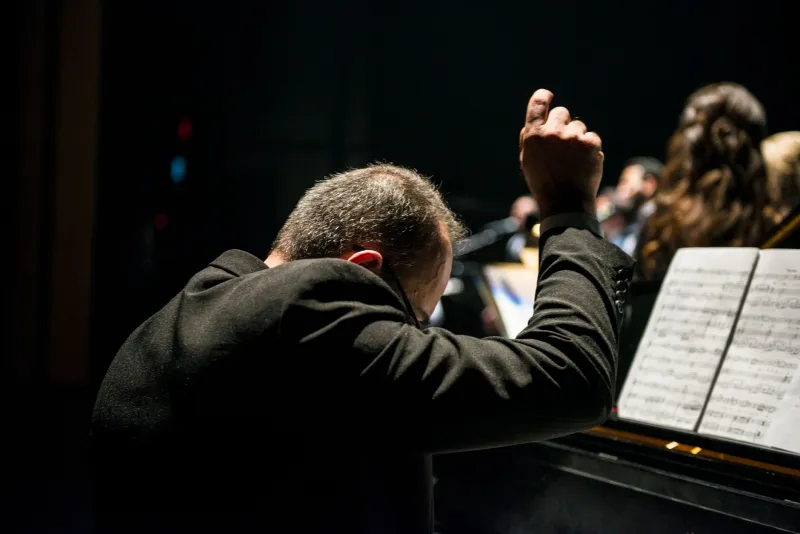
The first time Evelyn Hartmann walked onto a professional orchestral stage with a baton in her hand, she later recalled, the musicians looked at her the way people look at something they don't quite have a category for. Not hostile, exactly. More like genuinely uncertain about what was supposed to happen next.
She understood the confusion. She was, by any conventional measure, the last person who should have been standing there. She had been profoundly deaf since the age of seven, when a childhood illness took most of what remained of her already limited hearing. She had never studied at a conservatory. She had never played in an orchestra. She had come to conducting not through the traditional pipeline of performance and pedagogy but through something stranger and more personal — a lifelong, almost physical relationship with music that had nothing to do with her ears.
What happened next, across a career that would span decades and three continents, turned out to be one of classical music's most quietly radical stories.
Learning Music Without Sound
Evelyn grew up in a household where music was constant. Her mother played piano. Her older brother was working through a trumpet method book with the kind of dedication that drove everyone else in the family slightly mad. For most of her early childhood, Evelyn participated in this world the way any kid does — imperfectly, enthusiastically, without much reflection on the mechanics of it.
When her hearing deteriorated significantly after her illness, the expectation — from doctors, from teachers, from well-meaning adults of every description — was that music would become inaccessible to her. A sad loss, everyone agreed, but an inevitable one.
Evelyn disagreed, though she didn't have the vocabulary for it at the time. What she knew was that music hadn't gone away. It had just changed addresses.
She discovered, partly by accident and partly through the kind of stubborn experimentation that characterizes people who refuse to accept the terms they've been given, that she could experience music through vibration with a specificity that surprised even her. Different instruments produced different vibrational signatures. Rhythm lived in the floor beneath her feet. Harmony, she found, she could feel in her chest and sternum in ways that were distinct and, with practice, legible. She began to develop an internal map of how a piece of music felt as a physical phenomenon, not just as an acoustic one.
This wasn't a consolation prize. It was a different instrument of perception, and she learned to play it.
The Podium Nobody Offered Her
Evelyn's path to conducting was not a straight line. For years, she worked in music education, developing methodologies for teaching music to deaf and hard-of-hearing students that drew on everything she had taught herself. She was good at it. She was also, by her own admission, quietly restless.
The conducting impulse came from watching. She attended concerts obsessively, sitting close enough to feel the stage vibrations, studying conductors with the focused attention of someone who was analyzing a physical language rather than simply enjoying a performance. She began to understand the baton not as a tool for beating time but as a system of communication — a visual and kinetic vocabulary that an orchestra learned to read collectively.
If that was what conducting was, she thought, then the question of whether she could hear the music was only one part of a much larger question.
Her first real opportunity came through a community orchestra whose director, facing a scheduling crisis, was desperate enough to let her take a rehearsal. She had prepared obsessively. She had developed a system of visual cues — specific gestures, modified from standard conducting technique, that communicated dynamics and expression in ways her musicians could read even without the subtle audio feedback a hearing conductor uses to self-correct in real time. She had worked with the orchestra's concertmaster in advance, establishing a partnership that would function as a kind of relay between her physical direction and the ensemble's response.
The rehearsal went well. The second one went better. By the third, something was clicking.
A Different Kind of Precision
Musicians who worked with Evelyn regularly described an experience that was, at first, disorienting and then, surprisingly, clarifying.
Because she couldn't rely on audio monitoring, she had developed an extraordinarily refined visual attention to the orchestra. She watched breathing, bow pressure, embouchure, posture — the physical precursors to sound rather than the sound itself. She caught preparation errors that hearing conductors often missed because they were listening for the result rather than watching for the cause. Her scores were annotated in ways that reflected this visual orientation, full of notations about physical gesture and ensemble sight lines that most conducting pedagogy didn't address.
She also brought a different relationship to silence. In music, silence is structural — it shapes phrase and meaning as surely as any note. For Evelyn, silence wasn't absence. It was a texture, a vibration of a different kind. Musicians reported that her handling of rests and fermatas was unusually specific, that she communicated something about the quality of silence she wanted in ways that were hard to articulate but immediately recognizable.
Some described it as conducting from the inside of the music rather than from above it.
Rewriting the Rules
Evelyn never became a household name in the way that the conductors who dominate classical music's commercial tier do. She didn't seek that kind of visibility, and the industry's gatekeepers were never entirely sure what to do with her story. Acknowledging her achievements too loudly raised uncomfortable questions about what those achievements implied — about the assumptions baked into conservatory training, about who classical music imagines as its practitioners, about what it actually means to understand a piece of music.
But among musicians, her reputation was specific and real. Orchestras that worked with her came back. Young conductors sought her out for mentorship. Music educators borrowed her techniques and found them effective far beyond the context of deaf education.
What she had built, without institutional support and against the grain of an art form that prizes tradition above most other things, was a new vocabulary for an ancient practice. She hadn't proved that you didn't need to hear music to conduct it. She had proved something more interesting — that there were ways of knowing music that hearing alone had never accessed.
The podium, it turned out, had always been bigger than anyone thought.