When Everything Goes Wrong at Once
John Callahan was drunk when he got into that car in 1972. He was drunk most of the time back then, a 21-year-old Irish Catholic kid from Portland who'd been drinking since he was 12. The accident that followed—a high-speed crash that severed his spinal cord and left him paralyzed from the chest down—should have been the end of his story.
Instead, it was the beginning.
Most people know the polite version of disability success stories. The inspiring athlete who overcomes adversity. The brave soul who never loses hope. Callahan's story isn't that. His story is messier, angrier, and infinitely more honest. It's about a man who discovered that losing the use of his hands was nothing compared to what he'd already lost to alcohol—and how gripping a pen between his palms became his path to both sobriety and artistic freedom.
Drawing With Broken Tools
The conventional wisdom says you need fine motor control to be a cartoonist. Callahan proved that wrong every day for three decades. After months of rehabilitation, he taught himself to draw by wedging a pen between his palms and moving his entire upper body to create lines. The technique was crude, but it produced something no art school could teach: absolute authenticity.
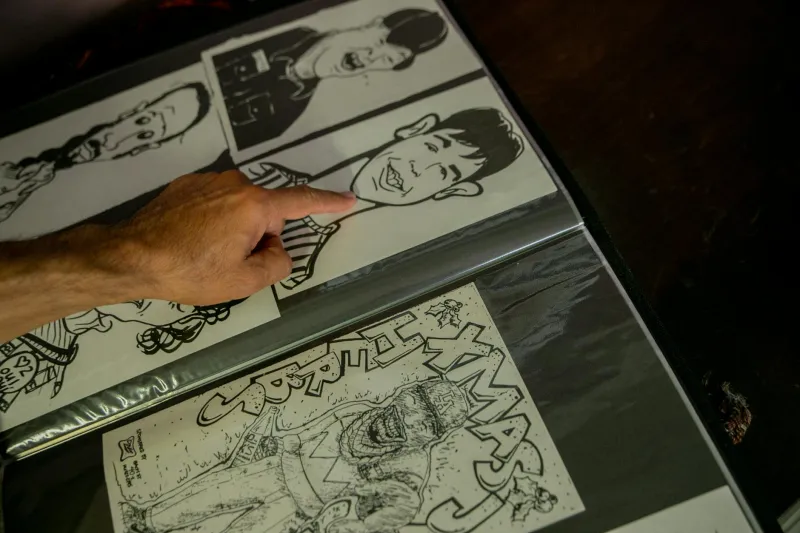
His cartoons were simple black-and-white drawings with devastating captions. A man in a wheelchair at the bottom of a ski slope with the caption "How about those Paralympics?" A woman pushing her husband's wheelchair toward a cliff: "Don't worry, honey—it's a ramp for the handicapped." These weren't jokes designed to make anyone comfortable. They were truth bombs delivered with surgical precision.
The Portland alternative weekly Willamette Week published his first cartoon in 1983. Within months, newspapers across the country were either embracing or banning his work. There was no middle ground with Callahan—you either got the joke or you became it.
The Business of Being Uncomfortable
By the 1990s, Callahan's cartoons appeared in over 200 publications nationwide. His autobiography, "Don't Worry, He Won't Get Far on Foot," became a bestseller. He had gallery shows in New York and Los Angeles. Not bad for someone whose art teachers at Portland Community College initially suggested he try something "more suitable."
The secret to Callahan's commercial success wasn't just his disability—it was his refusal to let disability define the conversation. While advocacy groups debated representation and sensitivity, Callahan was busy making fun of everyone, including himself. His cartoons featured blind people, amputees, and wheelchair users as fully realized characters capable of being jerks, heroes, or anything in between.
"I'm not a disabled cartoonist," he'd tell interviewers. "I'm a cartoonist who happens to be disabled. There's a difference."
The Method Behind the Madness
Callahan's artistic process was unlike anyone else's in the business. He'd wake up each morning—sober, thanks to AA meetings that became as essential as physical therapy—and spend hours drawing until his shoulders cramped. No preliminary sketches. No digital tools. Just a man, a pen, and whatever twisted observation had occurred to him the night before.
His subjects ranged from disability rights to religion to relationships, but they all shared one thing: they punctured pretense. A cartoon showing Jesus on the cross with the caption "T.G.I.F." got him death threats and hate mail. It also got him a profile in People magazine and speaking gigs at universities across the country.
"Humor is the only honest response to a meaningless universe," Callahan once said. "Everything else is just denial."
Legacy of an Unlikely Legend
When Callahan died in 2010, obituaries struggled to categorize him. Was he a disability rights activist? An underground comic artist? A recovering alcoholic who found his voice? The answer was all of the above and none of them.
What he really was: proof that the most powerful art comes from the most unlikely places. His cartoons hang in the Smithsonian now, next to works by artists who had every advantage he lacked. The kid who flunked out of high school and nearly died in a drunk driving accident became one of the most distinctive voices in American humor.
The accident that broke John Callahan's body didn't break his spirit—it revealed it. Sometimes the worst thing that can happen to you is also the best thing, if you're brave enough to grip the pen and start drawing.