The Government Nobody Who Took On Big Chemical and Won

The Nature Writer Nobody Took Seriously
In 1958, Rachel Carson was exactly the kind of person the scientific establishment loved to ignore. A 51-year-old federal employee who worked for the Fish and Wildlife Service, writing pamphlets about conservation and penning lyrical nature articles for magazines in her spare time. She had never held a major academic position, never run a laboratory, never published groundbreaking research.
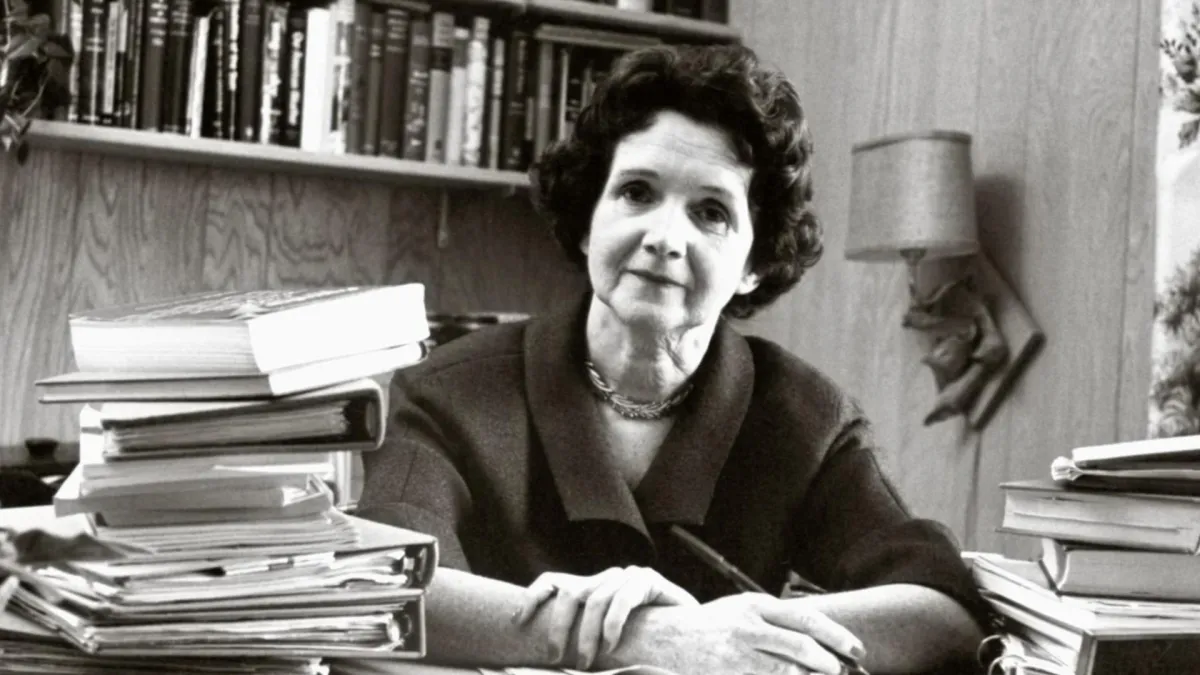 Photo: Rachel Carson, via image.pbs.org
She was also about to take on the most powerful industry in America—and win.
The Letter That Started a Revolution
It began with a letter from Olga Huckins, a friend who ran a bird sanctuary in Massachusetts. Huckins described watching songbirds die en masse after the state sprayed DDT to kill mosquitoes. The birds didn't just die—they convulsed, their bodies wracked with tremors before going still.
Carson had been hearing similar stories for years through her work with Fish and Wildlife, but this letter was different. It was personal, urgent, filled with the kind of detailed observation that her scientific training had taught her to value. More importantly, it came at a moment when Carson desperately needed a new project.
The Poverty That Freed Her Mind
Carson's life had been a series of financial crises that paradoxically prepared her for the fight ahead. Born in rural Pennsylvania to a family that struggled to pay bills, she had worked her way through college, then graduate school, supporting her mother and two nieces after family tragedies left her as their sole provider.
By 1958, she had finally achieved some financial stability through her nature writing, particularly "The Sea Around Us," which became an unexpected bestseller. For the first time in her adult life, she could afford to turn down assignments and pursue work that mattered to her personally.
That freedom was about to cost her everything.
The Research That Changed Everything
Carson spent four years investigating pesticides, working mostly alone at her kitchen table in Silver Spring, Maryland. She corresponded with scientists across the country, many of whom were afraid to speak publicly about their concerns. The chemical industry's influence was everywhere—funding research, sponsoring conferences, employing the very scientists who were supposed to regulate them.
 Photo: Silver Spring, Maryland, via www.bridgeandtunnelclub.com
What Carson discovered horrified her. DDT and other pesticides weren't just killing insects—they were accumulating in the food chain, causing cancer in laboratory animals, and devastating bird populations. Bald eagles were disappearing. Peregrine falcons were laying eggs so thin they cracked under the weight of the parent birds.
The chemicals that had been hailed as miracle weapons against disease-carrying insects were poisoning the entire natural world.
Writing Under Fire
As word of Carson's research leaked out, the attacks began before her book was even finished. The chemical industry launched a preemptive strike, questioning her credentials, her motives, even her mental health. She was called "a hysterical woman" and "a bird and bunny lover" who didn't understand modern agriculture.
Meanwhile, Carson was battling breast cancer, undergoing radiation treatments that left her weak and nauseated. She would work for a few hours in the morning, then spend the afternoon recovering, then work again in the evening. The book that would become "Silent Spring" was literally written between cancer treatments.
The Spring That Wouldn't Come
When "Silent Spring" was published in September 1962, it opened with one of the most haunting passages in American environmental writing: a description of a town where no birds sang, where fish floated dead in streams, where children played in yards dusted with poison.
Carson called it a fable, but readers understood it as prophecy. If current trends continued, she warned, America would face springs silent of birdsong, summers empty of butterflies, autumns without the migration of songbirds.
The book was an immediate sensation and an immediate target. Chemical companies spent hundreds of thousands of dollars trying to discredit it. They produced their own studies, funded their own experts, launched advertising campaigns that portrayed Carson as an enemy of progress.
The Scientist Who Wouldn't Back Down
Carson had expected the attacks, but their intensity still shocked her. At scientific conferences, colleagues who had privately supported her research now avoided her. Government agencies that had once welcomed her input suddenly found reasons to exclude her from meetings.
But Carson had something her critics didn't: meticulous documentation. Every claim in "Silent Spring" was backed by peer-reviewed research, government studies, and extensive field observations. When challenged, she responded not with emotion but with data.
The public began to listen. Sales of DDT plummeted. Birdwatching groups organized boycotts of chemical companies. Suburban mothers started reading ingredient labels on pest control products.
The Victory She Didn't Live to See
Carson died in April 1964, just eighteen months after "Silent Spring" was published. She was 56 years old, worn down by cancer and the stress of defending her work against an industry that seemed determined to destroy her reputation.
She didn't live to see DDT banned in the United States in 1972. She didn't see the creation of the Environmental Protection Agency, which cited her work as foundational to its mission. She didn't witness the recovery of bald eagles and peregrine falcons, species that came back from the brink because of the movement she started.
The Bureaucrat Who Changed the World
Rachel Carson was never supposed to be a revolutionary. She was a government employee who liked birds, a quiet woman who preferred research to confrontation. But sometimes the most unlikely people find themselves in possession of inconvenient truths.
Her legacy isn't just environmental protection—it's the idea that ordinary citizens can challenge powerful industries and win, if they're armed with good science and the courage to speak uncomfortable truths. Sometimes the most important voices come from the places nobody thinks to listen.