The War Wound That Built an Empire: How Pain and Desperation Created America's Most Famous Recipe

The Cavalry Officer Who Couldn't Stay in the Saddle
Lieutenant Colonel John Stith Pemberton thought he was charging toward glory when he led his Confederate cavalry unit into battle at Columbus, Georgia in April 1865. Instead, he rode straight into a Union saber that sliced deep across his chest, leaving him wounded, defeated, and dependent on morphine for the crushing pain that would follow him for the rest of his life.
 Photo: Columbus, Georgia, via c8.alamy.com
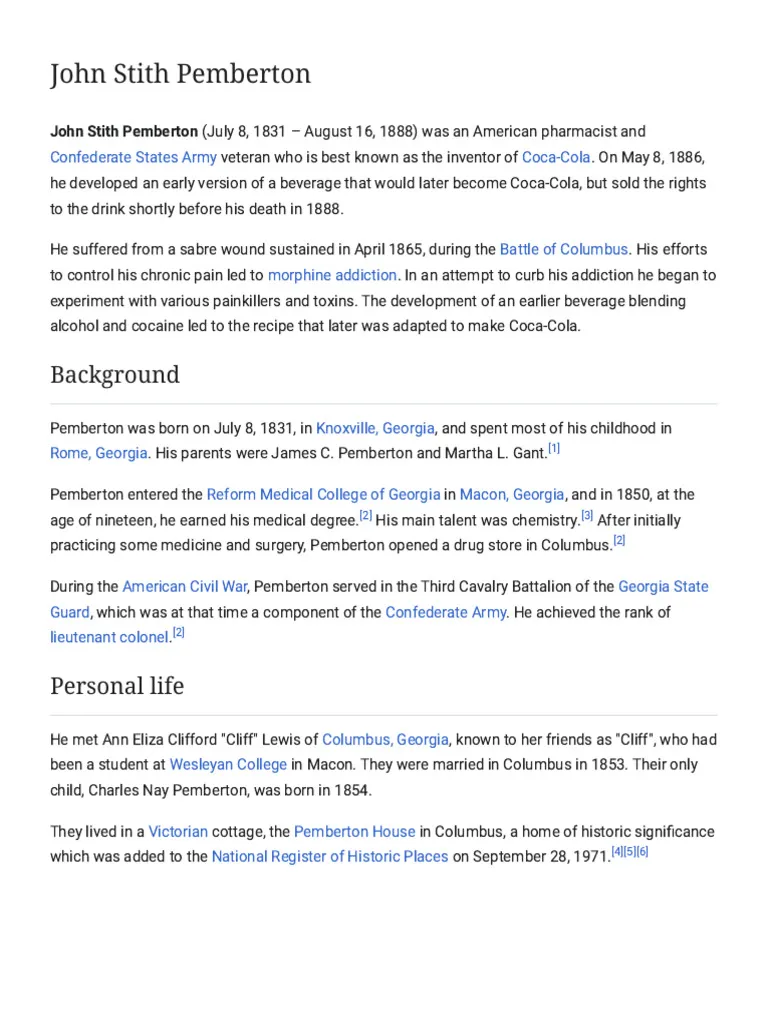 Photo: John Stith Pemberton, via imgv2-2-f.scribdassets.com
The Civil War was ending, the Confederacy was collapsing, and Pemberton found himself transformed from a respected military officer into just another broken veteran trying to piece together a future from the wreckage of the Old South. What he couldn't have imagined was that his desperate attempt to cure his own addiction would accidentally create the foundation of a business empire worth more than most countries' entire economies.
From Battlefield to Drugstore
Before the war, Pemberton had been a successful pharmacist in Columbus, Georgia, known for his skill at creating patent medicines and tonics. The conflict destroyed his business, scattered his customers, and left him with wounds that required constant medication just to function. When he finally returned to pharmacy work in Atlanta during Reconstruction, he was a different man—physically broken, financially desperate, and increasingly dependent on the morphine that dulled his chronic pain.
The Atlanta that Pemberton encountered in 1869 was a city trying to rebuild itself from ashes. Sherman's March to the Sea had left most of the downtown in ruins, but ambitious entrepreneurs were already laying plans for a New South built on commerce rather than cotton. Pemberton opened a small pharmacy and began experimenting with patent medicines, hoping to create something that might provide both financial security and relief from his own suffering.
His early attempts were typical of the era: tonics and elixirs that promised to cure everything from headaches to "female complaints." Most contained alcohol, cocaine, or opium—the holy trinity of 19th-century self-medication. Pemberton was essentially a legal drug dealer, but so was every other pharmacist in America.
The Desperate Search for a Cure
By the 1880s, Pemberton's morphine addiction had become a serious problem. The drug that had saved him from unbearable pain was now controlling his life, affecting his business judgment and threatening his family's financial stability. He had tried various cures and treatments, but nothing worked. Morphine addiction was barely understood in the 1880s, and effective treatment was virtually nonexistent.
Pemberton decided to create his own solution. He began experimenting with coca leaves, which were known to have stimulating properties that might counteract opium's depressive effects. Coca was legal, readily available from South America, and increasingly popular among patent medicine makers who praised its energizing qualities.
Working in his backyard laboratory—really just a brass kettle and some basic equipment—Pemberton began mixing coca extract with various other ingredients, searching for a formula that might wean him off morphine while still providing energy and pain relief.
The Accident That Changed Everything
On May 8, 1886, Pemberton was experimenting with a new mixture of coca leaves, kola nuts (for caffeine), sugar, and various flavoring agents. He was trying to create a medicinal syrup that could be mixed with water and consumed as a tonic. The formula was supposed to be another patent medicine—"Pemberton's French Wine Coca"—that would compete with similar products already on the market.
But when his assistant accidentally mixed the syrup with carbonated water instead of plain water, something magical happened. The resulting drink was refreshing, energizing, and surprisingly delicious. More importantly, it seemed to provide the stimulating effects Pemberton was seeking without the harsh medicinal taste that characterized most tonics.
Pemberton realized he might have stumbled onto something bigger than a patent medicine. This wasn't just a cure for addiction or a treatment for fatigue—it was a beverage that people might actually want to drink for pleasure.
Building a Business from Desperation
Pemberton partnered with Frank Robinson, his bookkeeper, to market the new drink. Robinson suggested the name "Coca-Cola" and designed the distinctive script logo that would become one of the world's most recognizable trademarks. They began selling the syrup to soda fountains around Atlanta for five cents a glass.
But Pemberton was a better inventor than businessman. His morphine addiction continued to cloud his judgment, and he made a series of financial decisions that nearly destroyed his creation before it could succeed. He sold portions of his Coca-Cola formula to various partners, creating a confusing web of ownership that threatened to tear the company apart.
Meanwhile, his health was deteriorating. The morphine that had started as treatment for war wounds had become his master, and the coca-based drink that was supposed to cure his addiction had instead become the foundation of someone else's fortune.
The Empire He Almost Lost
In 1888, just two years after creating Coca-Cola, Pemberton sold his remaining interest in the formula to Asa Candler for $2,300—roughly $70,000 in today's money. He was broke, sick, and convinced that his invention was just another failed patent medicine. He died that same year, never knowing that he had created what would become the world's most valuable brand.
Candler, recognizing the drink's potential, bought out the other partners and began the aggressive marketing campaign that would make Coca-Cola a national phenomenon. By 1895, Coke was being sold in every state. By 1900, it was an international brand. Today, Coca-Cola is consumed more than 1.9 billion times per day in more than 200 countries.
The Irony of Success
Pemberton's story is one of the great ironies in American business history. A man trying to cure his drug addiction accidentally created a product that would generate hundreds of billions of dollars in revenue. A Confederate veteran's attempt to rebuild his life after military defeat produced one of the most successful companies in human history.
The original Coca-Cola formula did contain small amounts of cocaine from the coca leaves, though not enough to produce significant psychoactive effects. The cocaine was completely removed by 1903, but the drink retained its energizing properties from caffeine and sugar.
More importantly, Pemberton had stumbled onto a business model that would define modern consumer culture: selling pleasure rather than necessity, creating desire rather than filling need, and building brand loyalty through consistent taste and aggressive marketing.
The Legacy of Accidental Genius
John Pemberton died believing he was a failure. His war wounds had derailed his military career, his addiction had destroyed his personal life, and his greatest invention had slipped through his fingers for a fraction of its true value. He couldn't have imagined that his desperate search for pain relief would create a global empire.
But Pemberton's real legacy isn't the Coca-Cola Company—it's the reminder that innovation often comes from the most desperate circumstances. Some of history's greatest breakthroughs happened not because someone set out to change the world, but because someone was trying to solve a personal problem and stumbled onto something universal.
The cavalry officer who couldn't stay in the saddle ended up creating something that would outlast every army that ever marched. Sometimes the wounds that seem to end our story are actually the beginning of someone else's—or, in Pemberton's case, the beginning of a story so big it would circle the globe.
Every time someone opens a Coke, they're tasting the result of one man's pain, desperation, and accidental genius. Not bad for a recipe born in a backyard brass kettle by someone just trying to make it through another day.