Seeing With Sound: The Blind Pitcher Who Made Baseball's Greatest Hitters Look Foolish
The Accident That Started Everything
Tom Wilder was twelve when the factory explosion took his sight. Birmingham's steel mills were dangerous places in 1923, especially for children who shouldn't have been working there in the first place. The blast that destroyed his vision also killed two men and changed the trajectory of a boy who'd dreamed of playing baseball.
Doctors told the Wilder family their son would need to learn new skills for a different kind of life. Blind children didn't play sports. They certainly didn't pitch baseballs at 90 miles per hour to professional hitters who could see perfectly well.
Tom had other ideas.
Learning to See Without Sight
The rehabilitation process was brutal. Tom spent months learning to navigate his family's small house, then their neighborhood, then the wider world of Birmingham's industrial district. But every afternoon, he insisted on returning to the vacant lot where neighborhood kids played baseball.
Initially, Tom just listened. He memorized the sound of different pitches—the sharp crack of a fastball hitting leather, the softer thud of a curveball, the whistle of air around a slider. He learned to identify hitters by their stance, their breathing, even the way they scraped dirt with their cleats.
Slowly, friends began including him in games. First as a base coach, calling out instructions. Then catching practice throws. Finally, inevitably, on the mound.
The Physics of Impossible
Wilder's pitching relied on acoustic precision that seemed supernatural to observers. He'd position himself using the sound of the catcher's glove, adjust his delivery based on the hitter's stance, and release pitches with mechanical consistency that sighted players envied.
His fastball was legendary—not just for its speed, but for its location. Wilder could paint corners with an accuracy that left professional scouts shaking their heads. Hitters described facing him as unsettling, not because they couldn't see his pitches, but because he seemed to know exactly where theirs were going.
The secret was sound. Wilder read hitters through audio cues that escaped everyone else—the slight shift of weight before a swing, the intake of breath before a bunt attempt, the subtle change in stance that telegraphed a stolen base. He was playing a different game entirely.
The Barnstorming Circuit
By 1932, Wilder had outgrown local competition. He joined the barnstorming circuit that crisscrossed the Depression-era South, where independent teams played exhibitions for crowds hungry for entertainment they could afford. These were baseball's margins—where players with extraordinary talents but wrong skin colors, broken bodies, or unconventional backgrounds found their stage.
Wilder's reputation spread through word of mouth. Promoters billed him as "Blind Tom," a novelty act who would strike out local heroes for the crowd's amusement. What they got instead was an education in what human capability actually looked like.
Game after game, Wilder dominated hitters who'd played professionally. His curveball was devastating, his control supernatural. Crowds came expecting a spectacle and left having witnessed something closer to a miracle.
Facing the Professionals
Wilder's most famous performance came against a touring team of major league all-stars in Atlanta, 1934. The professionals were making extra money during the off-season, playing exhibitions across the South. They expected to demolish local competition and collect easy paychecks.
Wilder struck out seven of the first nine hitters he faced. Babe Herman, who'd hit .324 for the Cubs that season, couldn't touch his curveball. Joe Medwick, the Cardinals' future Hall of Famer, went down swinging on three pitches.
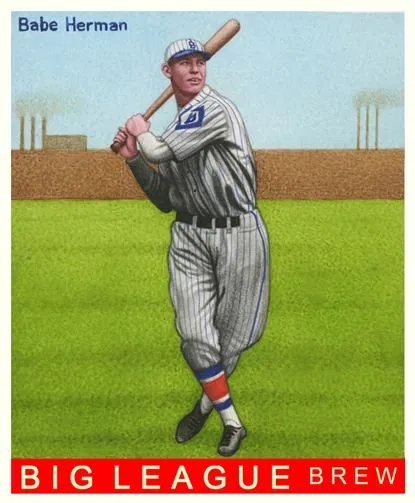 Photo: Babe Herman, via alchetron.com
The crowd was silent, then erupted. These weren't local amateurs getting lucky—these were professionals being systematically dismantled by a blind pitcher who threw harder and more accurately than most sighted players they'd faced all season.
The Underground Railroad of Talent
Wilder's story illuminates the parallel universe of Depression-era baseball, where extraordinary athletes performed for audiences that mainstream sports ignored. The barnstorming circuit included Negro League stars, players too old for organized baseball, and athletes with disabilities who'd never get a chance in the majors.
This underground produced some of the most remarkable athletic performances in American history. Without the pressure of statistics or scouting reports, players were free to experiment, to push boundaries, to attempt things that would be considered impossible in more formal settings.
Wilder fit perfectly into this world. His blindness, which would have disqualified him from organized baseball, became his signature. Crowds paid to see the impossible made routine.
The Science of Sound
Modern sports science has begun to understand what Wilder accomplished through intuition. Research on spatial audio processing shows that blind individuals often develop enhanced acoustic awareness that can substitute for visual information in predictable environments.
Wilder was essentially using echolocation to pitch—reading the subtle sound signatures that revealed batter positioning, timing, and intention. His brain had rewired itself to process acoustic information with the speed and precision normally reserved for visual processing.
What seemed supernatural to 1930s audiences was actually neuroplasticity in action. Wilder's accident had forced his brain to develop capabilities that sighted players never needed to cultivate.
Legacy in the Shadows
Wilder continued barnstorming until 1941, when World War II disrupted the circuit that had sustained him. He returned to Birmingham, worked in a factory (safely this time), and taught baseball to local kids until his death in 1967.
No official records exist of his career statistics. The barnstorming circuit operated outside organized baseball's documentation system. Wilder's achievements live only in the memories of players who faced him and spectators who witnessed his impossible performances.
But his legacy extends beyond numbers. Wilder proved that excellence finds expression regardless of circumstances, that human capability exceeds our assumptions about what's possible, and that sometimes the most extraordinary athletes are the ones history forgets to record.
Seeing the Unseen
Wilder's story challenges every assumption about athletic ability, competitive advantage, and human potential. He succeeded not despite his blindness, but through capabilities that blindness had forced him to develop. His limitation became his strength.
In a sport obsessed with visual information—watching the ball, reading pitches, tracking movement—Wilder succeeded through pure audio processing. He was playing baseball in a different sensory dimension, one that gave him advantages sighted players couldn't comprehend.
The crowds who came to see a novelty act witnessed something more profound: proof that human beings adapt, overcome, and excel in ways that defy every expectation about what should be possible. Tom Wilder couldn't see the strikes he threw, but he could hear them perfectly.