Street Corners to Skyscrapers: The Dropout Who Built a Sneaker Empire From Nothing
There's a version of the American success story that starts in a garage in Palo Alto, or maybe a dorm room at Stanford. It usually involves a whiteboard, a pitch deck, and at least one angel investor who believed in the vision. That version is fine. But it leaves out a whole lot of America.
The story of how one high school dropout went from working the door at a grimy nightclub to running a sneaker empire worth billions doesn't fit neatly into any business school curriculum. And honestly, that might be the whole point.
The Education You Can't Buy
Growing up in one of the roughest pockets of urban America, he learned to read rooms before he could read balance sheets. Working as a bouncer in his late teens, he developed a skill that would eventually make him very, very rich: he could tell, almost instantly, what people wanted before they knew they wanted it.
At the door of a club, that meant knowing who was going to cause trouble. In business, it meant spotting a market gap six months before anyone else even noticed the category existed.
He dropped out of high school not because he was lazy or lost, but because the institution felt entirely disconnected from the world he was actually living in. The street had its own economy — its own rules of supply, demand, credibility, and taste. And he was studying it every single night, standing at that velvet rope, watching what people wore, how they carried themselves, what they were willing to spend money on to feel like they belonged.
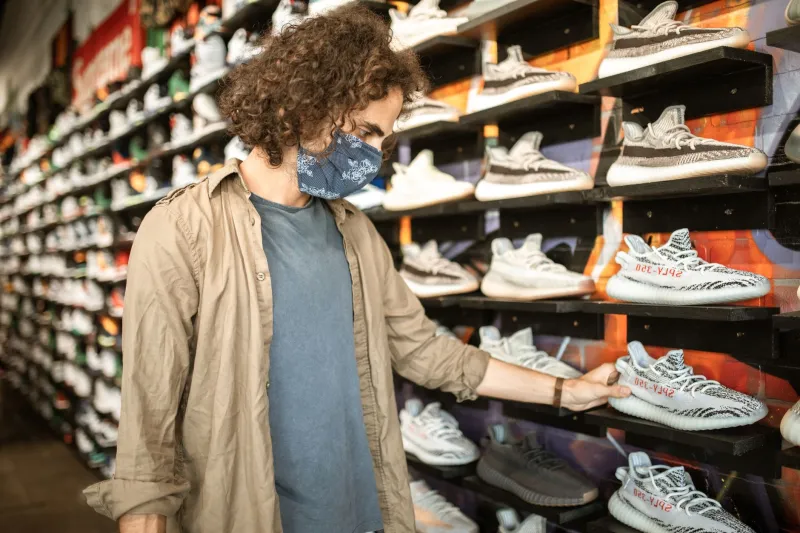
Sneakers, he noticed, weren't shoes. They were a language.
Reading the Market Nobody Was Watching
In the late 1980s and early 1990s, the major athletic brands were focused almost entirely on performance — faster runners, higher jumpers, stronger athletes. What they were missing, what they consistently failed to understand, was that most of the people buying their shoes had no intention of ever running a race. They were buying identity. They were buying belonging.
He saw this clearly because he lived it. The kids in his neighborhood weren't saving up for sneakers because they wanted to run faster. They were saving up because the right pair on your feet announced something to the world about who you were and where you stood.
With almost no startup capital — mostly personal savings scraped together from years of bouncing and odd jobs — he opened a small storefront in a neighborhood the major retailers had written off entirely. No fancy fixtures. No glossy marketing campaign. Just the right shoes, displayed the right way, in a place where the right people would find them.
Word spread the way it always does in tight communities: fast and with authority. Within a year, he had a line out the door on weekends.
When the Skeptics Showed Up
The business press, when they finally noticed him, didn't quite know what to make of the operation. A few profiles described him as a "street entrepreneur" — which was meant, in that particular era, as a polite way of saying they weren't sure he was entirely legitimate. Investors passed. Banks were skeptical. One particularly memorable meeting ended with a loan officer explaining, in careful language, that his "business model lacked institutional credibility."
He left that meeting and opened his second store.
What the skeptics couldn't account for was that his credibility was the business model. The communities he served trusted him because he was one of them. He hadn't parachuted in from some corporate headquarters to sell them a lifestyle. He'd been there. He'd stood at the corner. He knew the names of the kids who would make or break a product's reputation before any marketing team got hold of it.
In an era before social media, before influencer culture had a name, he had built the most powerful distribution network imaginable: authentic word of mouth in communities that the mainstream industry desperately wanted to reach but couldn't figure out how to speak to.
Scaling the Unscalable
Growth, when it came, came fast. By the mid-1990s, he had multiple locations, a small staff, and the attention of brand executives who had spent years trying to crack the exact markets he'd already conquered. He negotiated deals from a position of genuine leverage — not because of his credit rating or his Rolodex, but because he could deliver something money alone couldn't manufacture: cultural authenticity.
He brought on a small team, almost all of them people from similar backgrounds, people who had the same instinctive read on what the streets would embrace and what they'd reject. His internal meetings looked nothing like a traditional boardroom. They looked more like the conversations he'd been having his whole life — direct, opinionated, rooted in real observation rather than market research reports.
As the brand expanded nationally, and eventually internationally, that core approach never really changed. Every major product decision still got filtered through the same basic question he'd been asking since his first storefront: does this feel real, or does it feel like someone in a suit trying to seem cool?
What the Business Schools Eventually Figured Out
It took a while, but the academic world caught up. Case studies started appearing at Wharton and Harvard Business School, analyzing what he had done in the language of disruption theory and market segmentation. Professors explained, in retrospect, the strategic genius of targeting underserved communities as early adopters, of leveraging cultural capital as a competitive moat.
He found this mildly amusing.
None of it was theory when he was doing it. It was just paying attention. It was just taking seriously the people and places that the mainstream industry had decided weren't worth their time.
That, in the end, might be the most transferable lesson in the whole unlikely story. The market gaps that look obvious in hindsight are usually sitting right in front of the people who've been told they don't have the credentials to spot them. Sometimes the best business education is the one you get when nobody's watching — standing at a door, reading a room, night after night, until you finally understand exactly what the world is looking for.